Applications
I do not select a process because it is conventional in a particular industry. I start from what the part has to survive and what cannot be allowed to change.
Selected development & application cases
The application range is not based only on a technology matrix. Published work includes full-size high-precision gears, gearbox separators, turbine and compressor blades, steam-control components, internal cavities, tools and tribological pairs.
I have pulled the strongest examples into a separate evidence-led page, including quantitative results where the source supports them and explicit cautions where a result should not be generalized.
Two examples
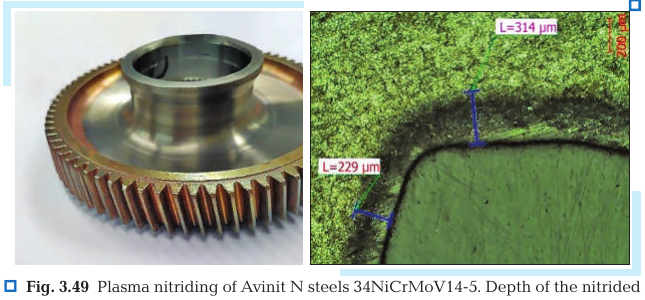
High-precision gear: published dimensional preservation within 1–2 μm after Avinit N nitriding.
Contact fatigue: a defined comparative test programme reported more than 10× higher multi-cycle fatigue-wear resistance than the cemented comparison specimens.
Precision mechanics, gears and friction units
Gears, shafts, separators, plungers, hydraulic spools and valve components are good examples of why a surface process cannot be discussed separately from geometry. A treatment may improve hardness or wear resistance and still be unacceptable if it changes dimensions, edge condition or the behaviour of a mating surface.
This is where plasma nitriding, LPC, duplex treatment and low-friction coatings become comparable only after the required layer, tolerances and tribological pair are defined.
Aerospace and turbomachinery
Turbine and compressor components bring erosion, temperature, oxidation, complex geometry and internal surfaces into the same problem. Some of my earlier work includes protective and functional coatings for gas-turbine components and coating of internal cavities of cooled blades.
Tools, dies and wear-loaded parts
For tools and dies, hard coating performance depends heavily on substrate hardness, support, edge preparation and adhesion. The coating name alone is not a reliable predictor of life.
Vacuum furnaces and process equipment
In equipment projects the “application” is the process itself: brazing, sintering, LPC, nitriding, PVD/CVD or research processing. The main task is to connect the requested process window with chamber architecture, pumping, heating, gas handling, control and acceptance data.
Electric propulsion and TVAC
Here the part under test and the chamber form one coupled system. Xenon flow changes chamber pressure and pumping requirements; cathodes add their own ignition and thermal constraints; contamination and diagnostics can influence the interpretation of the test.
One rule I use repeatedly
A replacement process should be validated against the function of the part, not against the name of the old process. Replacing gas carburizing with LPC, or a conventional nitriding route with plasma nitriding, still requires the case profile, microstructure, distortion and tribological behaviour to be checked for the real component.
From application to validation
Application map
Follow the route from functional requirement and failure mode through process physics, equipment architecture, verification and the external industry / patent landscape.
Surface-engineering depth
Go deeper into Avinit diffusion treatments, coatings, duplex systems, geometry and tribological validation.
LPC validation
Qualification logic for case profile, microstructure, quench, distortion and repeatability on the real component.
Cathode validation
Qualification logic for ignition, transition, thermal closure, restart, erosion and lifetime evidence.
See the component evidence
For the strongest application areas I have separated the actual parts, test results and source figures from the general applications overview: gears, gearbox separators, turbine and compressor blades, steam-turbine bearings, diesel pistons, tools and nitrided titanium components.