A small selection from a much larger body of coating, nitriding and duplex surface-engineering work.
I have deliberately kept this page component-focused. The useful question is not whether a coating or nitriding process can produce a hard layer on a laboratory coupon, but what happened when the route was applied to a gear, separator, blade, tool, internal cavity or friction pair.
The level of validation is not identical in every case. Some are component or bench tests with quantitative results; others document developed and published application routes. I keep that distinction visible rather than turning all of them into marketing success stories.
Selected photographs, component images and microstructures from the published Avinit monographs.
High-precision gear and nitrided-layer section. Source: aviation monograph.Freewheel-clutch separator and duplex layer. Source: aviation monograph.Long turbine blades with Avinit coating. Technical archive.
Cases
Aviation · precision surface engineering
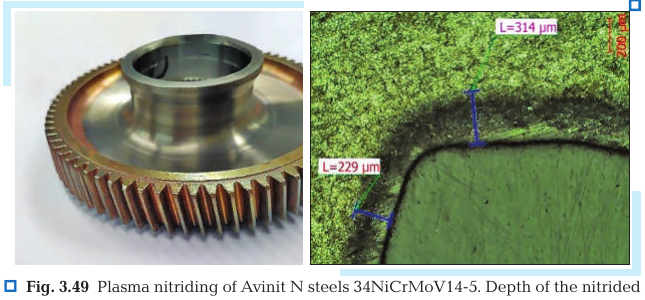
High-precision full-size gears — precision nitriding after final machining
Engineering problem. For a high-accuracy gear, conventional hardening can be technically successful and still be unacceptable if tooth geometry moves outside tolerance.
Route. Avinit N precision plasma nitriding of the finished gear, followed in the duplex route by a thin low-friction Avinit C coating.
What was demonstrated. The published monograph reports a gear manufactured to accuracy grade 4, with original dimensions retained within 1–2 μm before and after nitriding. No change in tooth geometry was detected after engine-gearbox testing.
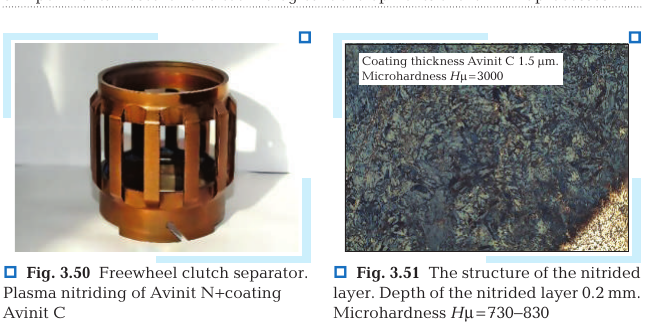
Freewheel-clutch gearbox separator — nitrided support layer + hard functional coating
Engineering problem. Separator working surfaces are exposed to fretting/contact loading. A thin coating alone can fail if the substrate does not provide enough load support.
Route. Avinit N plasma nitriding followed by a superhard Avinit C coating as a duplex surface system.
What was demonstrated. Bench testing reported no fretting wear on the treated working surfaces, in contrast with the characteristic fretting observed on commercial separators in the referenced study.
Freewheel-clutch separator and the Avinit N + Avinit C layer. Source: aviation technology monograph, Figs. 3.50–3.51.
The result belongs to the tested separator configuration and bench conditions; broader service-life claims require component-specific qualification.
Precision plasma nitriding versus carburizing — contact-fatigue test case
Engineering problem. For precision parts, the engineering question is not simply which process produces the deeper case, but whether the surface survives contact loading while preserving geometry and avoiding unnecessary post-machining.
Route. Comparative rolling-with-slip contact-fatigue testing of cemented and Avinit N plasma-nitrided specimens.
What was demonstrated. In the published test series, after 1,000,000 cycles the integral multi-cycle fatigue-wear resistance of Avinit N specimens with a 0.25 mm layer was reported as more than ten times that of the cemented comparison specimens with a 1.2 mm layer.
This is a striking result from one defined test programme, not a general statement that plasma nitriding is always superior to carburizing. Material, load, case architecture and application remain decisive.
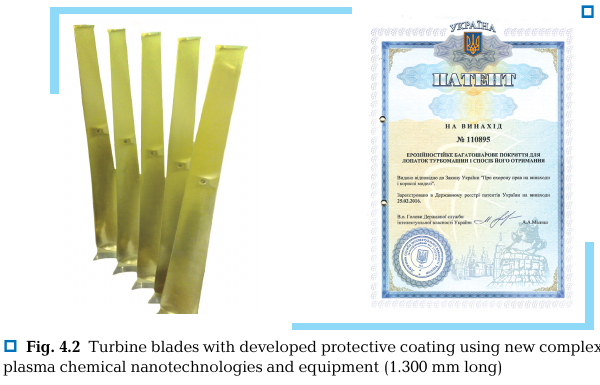
Turbine blades — multilayer vacuum-plasma protection against erosive environments
Engineering problem. Turbine blades combine aerodynamic sensitivity with salt/gas corrosion, gas-abrasive erosion and droplet-impact erosion. The coating must add protection without damaging profile, balance or fatigue behaviour.
Route. Multilayer / nanolayer vacuum-plasma systems with controlled surface preparation and ion-plasma treatment between deposition stages.
What was demonstrated. The turbine-blade monograph reports 1.5–2× higher resistance to salt corrosion and droplet-impact erosion for the described protective coating systems in the referenced test context.
Turbine blades with developed protective coating. Source: turbine-blade monograph, Fig. 4.2.
The reported multiplier belongs to the referenced blade/coating tests. Qualification for a particular turbine requires its own material, geometry and cyclic-loading evidence.
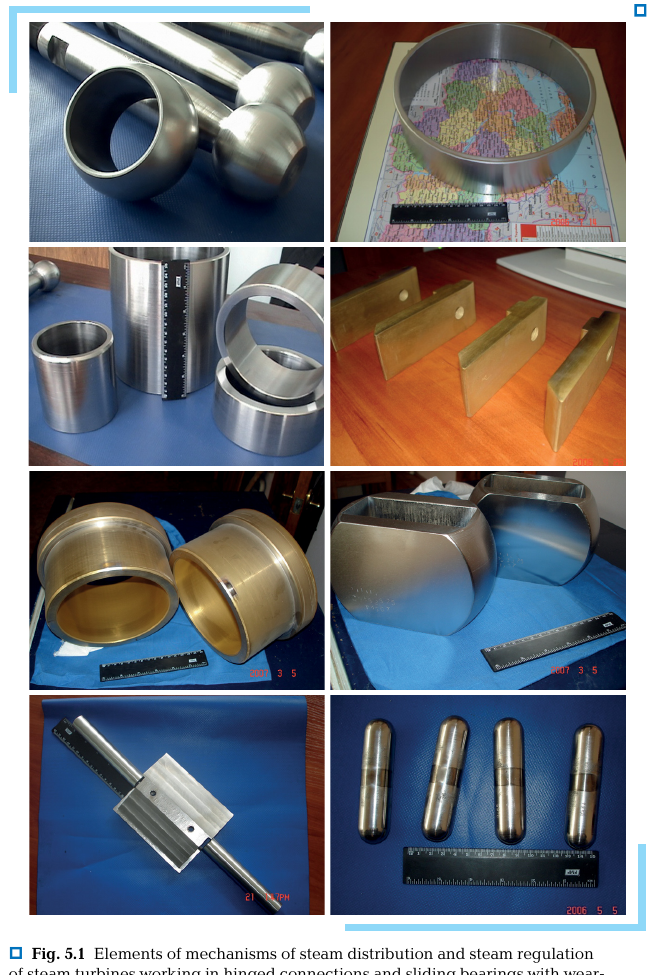
Steam-distribution sliding bearings — antifriction coatings under 280–520 °C service conditions
Engineering problem. Steam-distribution and steam-regulation mechanisms combine sliding contact, corrosion, temperature and local loads; seizure or unstable friction directly affects mechanism reliability.
Route. Multilayer wear-resistant antifriction Avinit coatings on sliding-bearing friction surfaces, valve stems and bushings.
What was demonstrated. The technical archive reports a 3–4× reduction in friction and a 5× increase in overall service life for the described steam-distribution mechanisms. The same archive documents serial use on turbine bearing components for multiple thermal and nuclear power-plant applications.
Steam-distribution and steam-regulation components working in hinged connections and sliding bearings. Source: turbine-blade monograph, Fig. 5.1.
These figures belong to the documented turbine-mechanism applications and should not be generalized to other bearing materials, lubricants or temperature ranges without qualification.
Engineering problem. Compressor blades operate in flows containing dust, moisture and other erosive agents while retaining a tightly controlled aerodynamic surface.
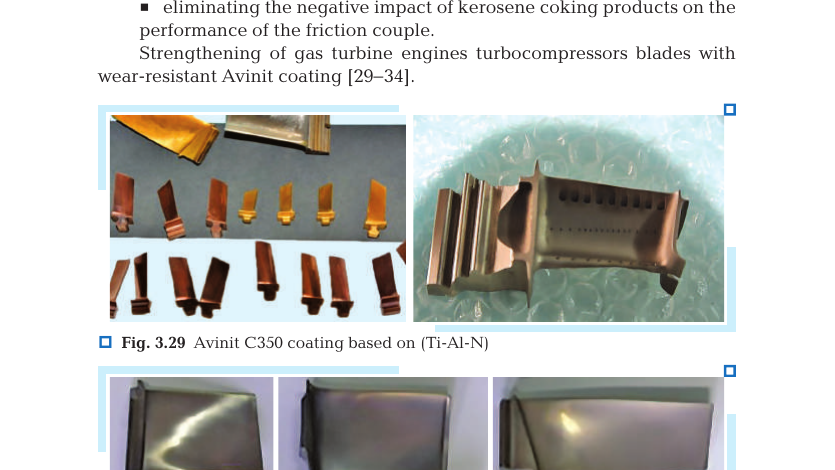
Route. Vacuum-plasma erosion-resistant 2D nanocomposite Avinit coating developed for gas-turbine-engine compressor blades.
What was demonstrated. The case progressed beyond generic coating coupons to compressor-blade application and peer-reviewed component-focused publication.
Examples of gas-turbine compressor blades and coating variants from the aviation monograph.
Use as evidence of developed and studied application; engine-specific life extension still depends on qualification conditions.
Internal cavities of cooled gas-turbine blades — coating where line-of-sight PVD is not enough
Engineering problem. Cooling channels and internal cavities are difficult to protect with line-of-sight deposition while their geometry must remain functional.
Route. CVD / plasma-chemical approach for internal surfaces, including the patented Cr–Al internal-cavity branch and later published work on CVD coatings for cooled GTE blades.
What was demonstrated. The work demonstrates a separate engineering route for internal-surface protection rather than assuming that an external-blade PVD process can simply be extended into narrow channels.
Internal-surface CVD requires specific control of temperature, precursor chemistry, gas dynamics and cleanliness.
Cutting and forming tools — hard / low-friction coating on new and reground tools
Engineering problem. Tool life is controlled by wear, friction, scuffing and edge condition, while recoating must remain compatible with regrinding and serial-process repeatability.
Route. Wear-resistant ion-plasma Avinit coatings, with coating selection tied to workpiece material, cutting/forming conditions and tool preparation.
What was demonstrated. Published Avinit work and related IP cover cutting/forming-tool coatings and report applicability to both new and reconditioned or reground tools.
The useful metric is tool life under a defined operation, not coating hardness by itself.
Multicomponent Avinit coatings — scoring and adhesion behaviour in friction tests
Engineering problem. For sliding contacts, a hard surface can still fail by adhesion or scoring. Coating selection has to consider the full tribopair, not only the coated specimen.
Route. Multicomponent and multilayer Avinit coating systems evaluated in abrasion, wear and friction-pair tests.
What was demonstrated. The turbine-blade monograph reports no signs of increased wear or adhesion on the coated working surfaces after the described tests and notes improved resistance to scoring, with multilayer variants outperforming the compared monolayer configuration in critical-load behaviour.
Tribological behaviour is strongly dependent on counterbody, load, speed, lubrication and surface finish; the test configuration must travel with the result.
Titanium-alloy nitriding — hard modified layer for low-mass precision components
Engineering problem. Titanium alloys are attractive structurally but have poor friction and wear behaviour. Internal or shielded surfaces add a second challenge for plasma access.
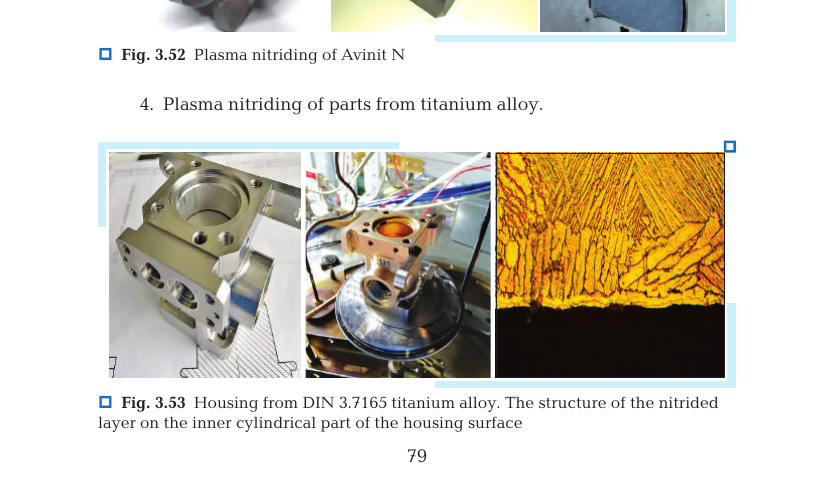
Route. Glow-discharge / hollow-cathode plasma nitriding studied on titanium alloys, including DIN 3.7165 material and complex-surface applications.
What was demonstrated. Published work documents nitrided-layer structure, nitrogen content and microhardness profiles and connects the route to housings, spools, guides and other components where low mass and surface durability must coexist.
Titanium-alloy housing and slide-valve examples with nitrided internal / working surfaces. Source: aviation technology monograph.
Titanium nitriding is material- and temperature-sensitive; this case shows the process branch, not a generic treatment window.
Aluminium diesel pistons — anti-scuff and wear-resistant nanocomposite coating
Engineering problem. Aluminium pistons combine low mass with a high risk of scuffing in loaded sliding contact; a protective layer must also preserve the manufactured surface.
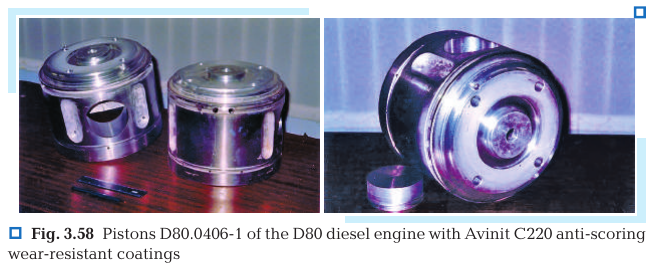
Route. Thin Avinit anti-scuff / wear-resistant nanocomposite coating on aluminium-alloy piston working surfaces.
What was demonstrated. The Avinit technical archive documents coated D80-type diesel pistons and describes the developed coating route for suppressing scuffing of aluminium pistons and piston skirts. It also reports application work on compression rings and related cylinder-piston-group parts.
The archive statement is application-specific; piston material, thermal state, lubrication and mating surface remain part of the qualification problem.
Punches and dies — industrial production tests with Avinit wear-resistant coatings
Engineering problem. Punching tools fail through edge wear, adhesion and friction; the useful metric is not coating hardness but how many production cycles the tool survives at a defined wear level.
Route. Wear-resistant / antifriction Avinit nanocomposite coating on Ø12 mm punches and matching dies.
What was demonstrated. The archived industrial test table for CNC vibro-punching reports strengthening factors from 5 to 43 depending on punch/die geometry and sheet thickness. For the 1 mm steel case, coated punches reached 161,805 impacts with 0.02 mm wear versus 46,230 impacts and 0.11 mm wear without coating; coated dies in the same set show a strengthening factor of 43.
Tool-life factors depend strongly on workpiece material, thickness, press mode, edge preparation and the wear criterion. The numbers above belong to the documented production test.
I do not copy an old process route into a new project. The cases are useful as published reference points and as a way to identify the variables that have to be re-qualified: material, geometry, layer architecture, contact condition, temperature, dimensional tolerance and test method.
That is especially important when deciding whether a process should replace an established route. A successful precision-nitriding gear case, for example, shows that the concept is technically credible; it is not a waiver of validation for a different steel, module, load spectrum or gearbox.