
Model idea
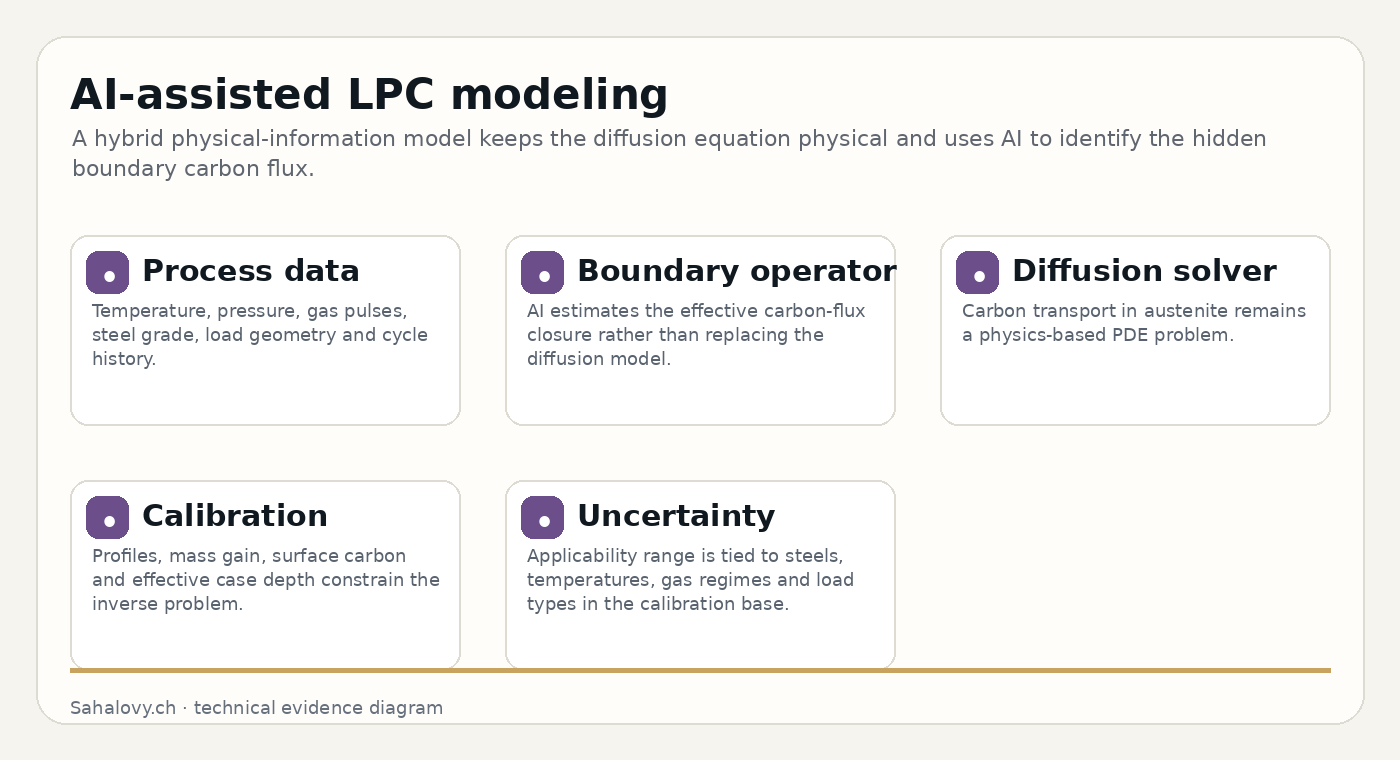
The proposed LPC model keeps carbon diffusion in austenite as a physics-based transport problem. Machine learning is used only for the least directly observable part: the boundary carbon flux at the gas-metal interface.
Boundary flux
In LPC the effective carbon flux depends on temperature, pressure, gas composition and flow, surface state, steel grade, load area, furnace design and prior boost/diffusion history. This makes the boundary condition the natural target for adaptive modelling.
Calibration data
Useful calibration data include carbon concentration profiles, surface carbon, mass gain, effective case depth, microstructure indicators and technological cycle parameters.
Engineering use
The model is positioned as an interpretable digital process-support tool. It should be validated against baseline flux models, tested outside training cycles and used only within a stated applicability range.